A toolbox talk is a short, informal briefing on one health and safety topic, usually held on site before work starts. HSE calls it "a short presentation to the workforce on a single aspect of health and safety".
What is it for?
It keeps one risk fresh in people's minds and gives them a chance to raise concerns. HSE lists toolbox talks as one way to involve workers in exploring the risks and how to deal with them.
Are they a legal requirement?
No law names them. Employers must give workers the information, instruction and supervision they need to work safely, and on construction sites CDM 2015 also requires a suitable site induction. Toolbox talks are a common way to meet those duties, and a signed attendance record helps show you did.
HSE doesn't set a frequency. Some firms hold one weekly, others whenever the work, the site or the risk changes. A short talk before a new task or after a near miss usually does more good than a fixed date in the diary.
What should it include?
1
One topic, with the risk it addresses.
2
Why it matters on this site, this week.
3
What good looks like, in three or four plain points.
4
A question to the team.
5
Any concerns raised, and what will be done about them.
6
Who attended, with signatures.
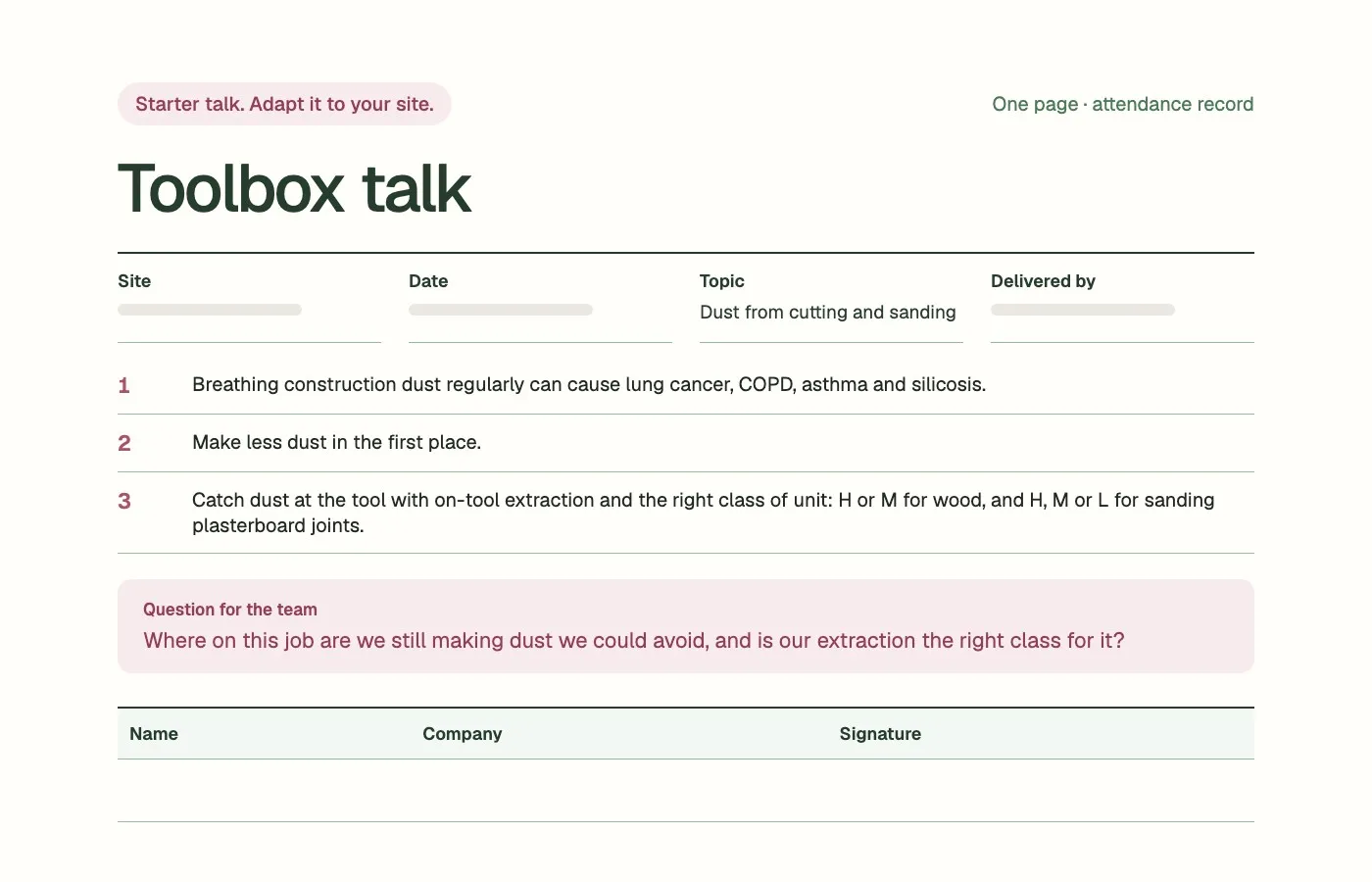
The toolbox talk template
Print it, fill it in on site and keep the signed sheet with your site records.
Toolbox talk
Have a competent person check the talk against the work on this site before you give it.
Site
Date
Topic
Delivered by
Key points
Three or four plain points about what good looks like on this site, this week.
1
2
3
4
Question for the team
Questions and concerns raised
Write down what the team says, in their words.
Actions agreed
Action
By whom
By when
Attendance
Name
Company
Signature
Everyone who attended signs. The Word file has room for 10 names.
For fit-out and building sites, each written from HSE guidance with four key points and a question for the team.
01
Working at height on stepladders and podiums
Starter talk. Adapt it to your site.
1Stepladders are for short, light work. HSE recommends other equipment if you'd be up a stepladder for more than 30 minutes at a time, so use a podium or tower with guard rails for longer jobs.
2Check it every time before you use it: the feet, the stiles, the steps, the platform and the locking bars. If anything is damaged, don't use it and tell your supervisor.
3Keep three points of contact at the working position: two feet and one hand, or two feet and your body against the steps when you need both hands for a moment.
4Don't work from the top three steps unless there's a suitable handhold. Don't overreach, carry only light tools and materials, and face the work rather than working side on.
Question for the team
Which job on this site has someone up a stepladder for more than half an hour, and what could we use instead?
1Breathing construction dust regularly can cause lung cancer, COPD, asthma and silicosis. The damage builds up slowly, and by the time anyone notices it can be serious and permanent.
2Make less dust in the first place. Order materials cut to size, use a less powerful tool where it does the job, and choose tapered-edge plasterboard so there's less jointing to sand.
3Catch dust at the tool with on-tool extraction and the right class of unit: H or M for wood, and H, M or L for sanding plasterboard joints. A general vacuum won't do. Clean up with a vacuum fitted to an H or M class unit.
4Masks are the last line of protection. Where you need one, use an FFP3 disposable mask or a half mask with a P3 filter. Tight-fitting masks need a face-fit test, and you need to be clean shaven to wear one.
Question for the team
Where on this job are we still making dust we could avoid, and is our extraction the right class for it?
1Injuries from handling boards rarely come from one lift. They build up from repeated poor lifting and awkward posture. HSE notes that special thermal or acoustic boards can weigh up to 50 kg each.
2Get materials delivered as close as possible to where they'll be used, by telehandler or hoist where you can, and move them on a trolley rather than by hand.
3If a board has to be carried by hand, it's a two-person job. Use carrying handles to get a proper grip.
4Use a ceiling lift or adjustable props for boards overhead, and a foot-operated board lifter for low wall panels so you're not stooping. Swap tasks during the day to break up repetitive work.
Question for the team
What are we still carrying by hand on this site that could go on a trolley or a hoist, or needs a second person?
1Know who else is working in your area today and what they're doing. If your work could affect theirs, or theirs yours, agree how you'll handle it before you start and tell the supervisor about any clash.
2Keep the work separate from the people who use the building. Use barriers and warning signs, stay inside the agreed area, and do the noisiest or dustiest work at the times agreed with the client.
3Make sure nothing can fall on anyone. Plan how materials go up and come down, avoid working above people, and keep the area under the work clear.
4Keep corridors and fire exits clear, store materials inside your work area, and know the building's fire alarm, escape routes and assembly point.
Question for the team
Who else is working near us today, and where could our work and theirs get in each other's way?
1A near miss is something that could have hurt someone but didn't, like a dropped tool, a board that slipped or a ladder that moved. HSE says near misses shouldn't be ignored, because they show how well health and safety is being managed.
2Report every near miss to your supervisor the same day, even if nobody was hurt and even if it was your own mistake. Reporting one should never get anyone into trouble.
3Write down what happened, where and when, while it's fresh. HSE calls a pattern of near misses an early warning that something needs attention.
4Some serious near misses, called dangerous occurrences, must be reported to HSE under RIDDOR. Your supervisor decides that. Your part is to tell them straight away.
Question for the team
What's the last near miss you saw on a site, and did anyone write it down?
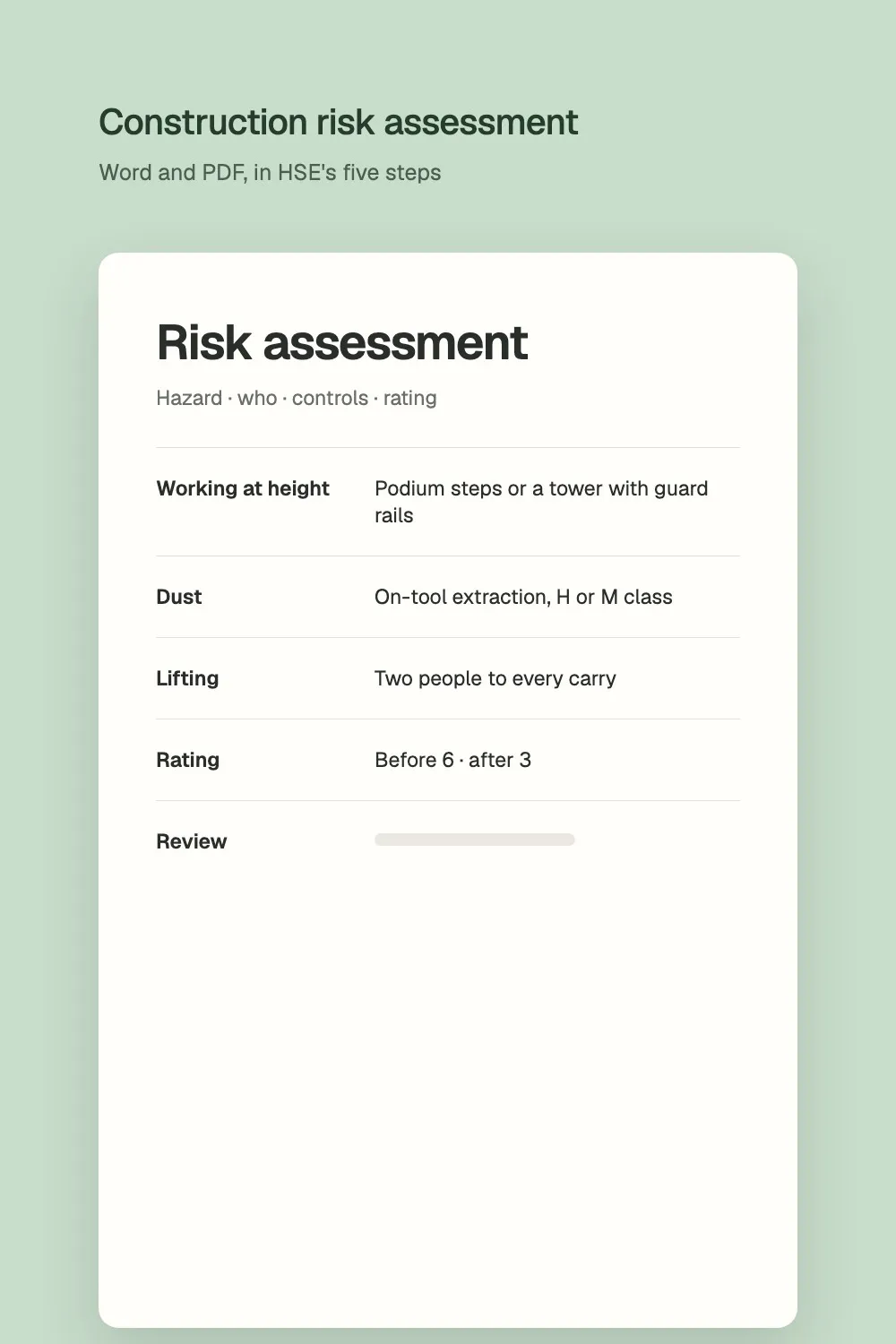
Pick one topic that matters on site this week, make a few plain points, ask a question and write down what the team says. Five minutes of conversation does more than a long talk read from a sheet. The hazards in your risk assessment are a good place to find this week's topic.
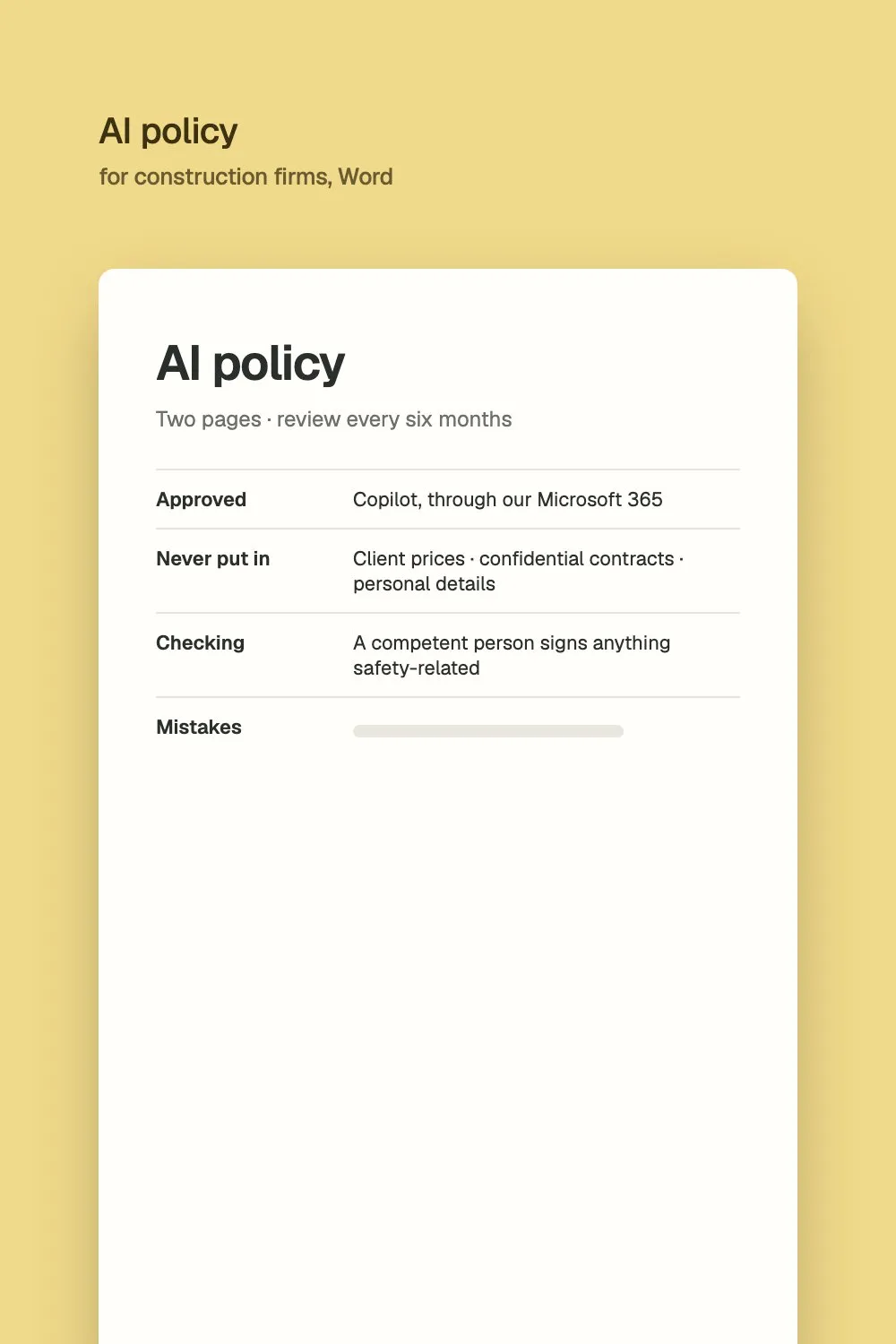
Can AI write toolbox talks?
Yes, quickly, which helps if you write one every week. Give it the task and the site conditions, and have a competent person check every point against the work.