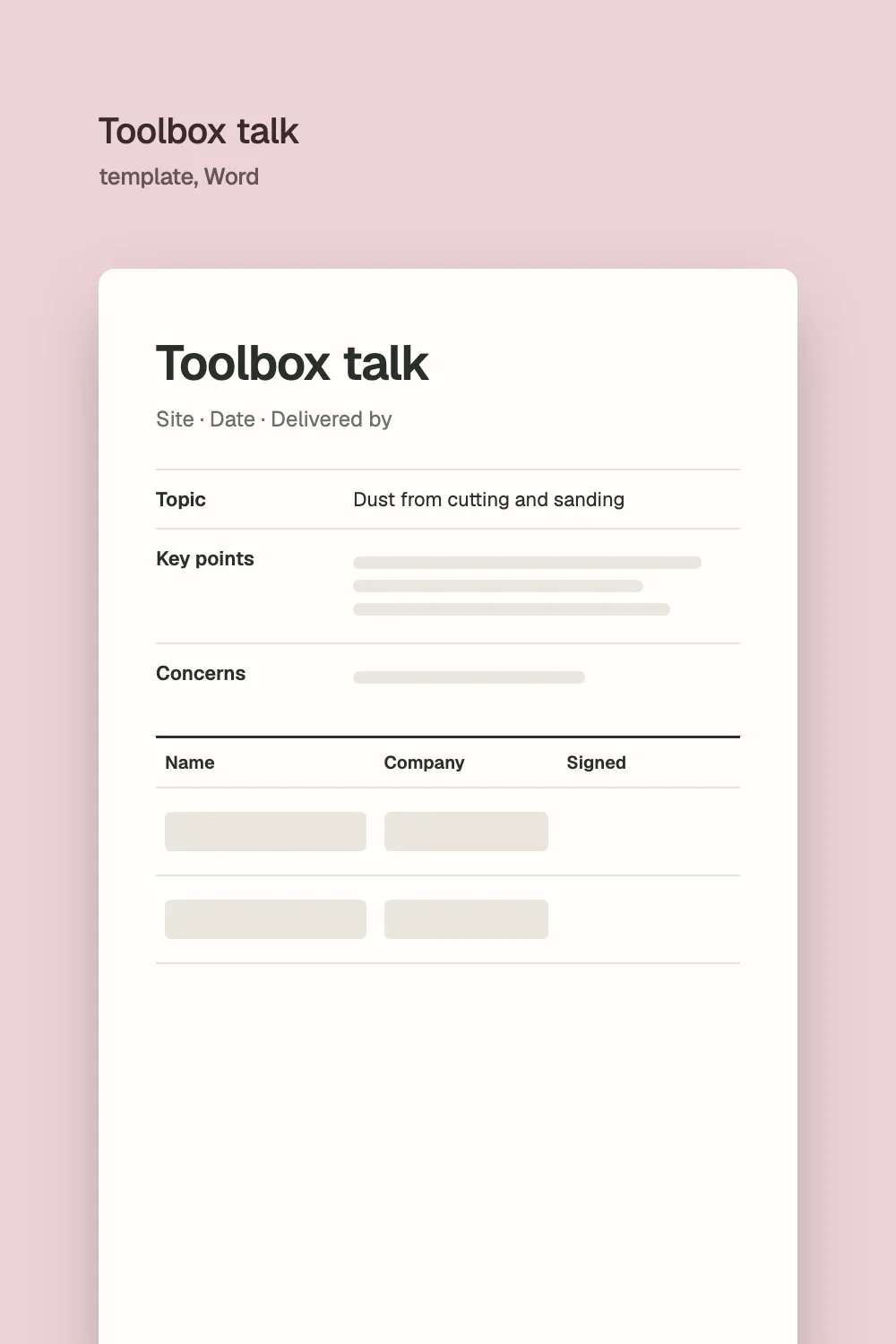
Toolbox talk
One page with a record of who attended, plus five starter talks
Last checked 4 October 2026
A free method statement and risk assessment template in Word and PDF, with no email needed. Below it you'll find what a method statement is, what it must cover, a short example, and how to draft one faster without cutting corners.
A method statement sets out, step by step, how a piece of work will be done safely. It describes the sequence of work, the people and equipment involved, and how each risk from the risk assessment will be controlled. Clients and principal contractors usually ask for one before work starts on site.
RAMS stands for risk assessment and method statement. The risk assessment identifies the hazards and how serious they are. The method statement explains how the work will be done to control them. RAMS is industry shorthand, not a term used in the regulations.
A risk assessment is a legal duty under the Management of Health and Safety at Work Regulations 1999, and employers with five or more people must record its significant findings. The regulations don't name a method statement. Clients and principal contractors usually require one, though, because it shows how the risks will be controlled on that job.
Source: Management of Health and Safety at Work Regulations 1999, regulation 3.
A risk assessment works out what could go wrong on the job and how serious it would be. A method statement takes those findings and sets out how the work will be done, step by step, so the risks stay controlled. The risk assessment is a legal duty, and the method statement is usually what your client asks to see.
| Question | Risk assessment | Method statement |
|---|---|---|
| What it answers | What could go wrong, who could be harmed, and how likely and serious it is | How the work will be done, step by step, so those risks are controlled |
| Required by law | Yes (Management Regulations 1999, reg 3) | Not named in law; usually required by the client or principal contractor |
| Who uses it | Managers and the person responsible for safety | The team doing the work, briefed before starting |
A good method statement covers the job, the order of work, the hazards and how each one is controlled, who does what, the plant and materials, and what happens in an emergency. Most follow the same twelve sections, in roughly this order:
Job details: site, client, principal contractor, dates and the version.
Scope of work: what is and isn't included.
Sequence of work: numbered steps in the order they happen.
Hazards and controls: linked to the risk assessment.
People and responsibilities: who supervises and who does each task.
Competence and permits: training, cards and any permits to work.
Plant, equipment and materials: with any hazardous substances.
PPE: what each task needs.
Emergency arrangements and first aid: first aider, alarm, assembly point and nearest A&E.
Environmental controls: dust, noise and waste.
Briefing record: who was briefed and when.
Review and sign-off: when it's reviewed and who signs.
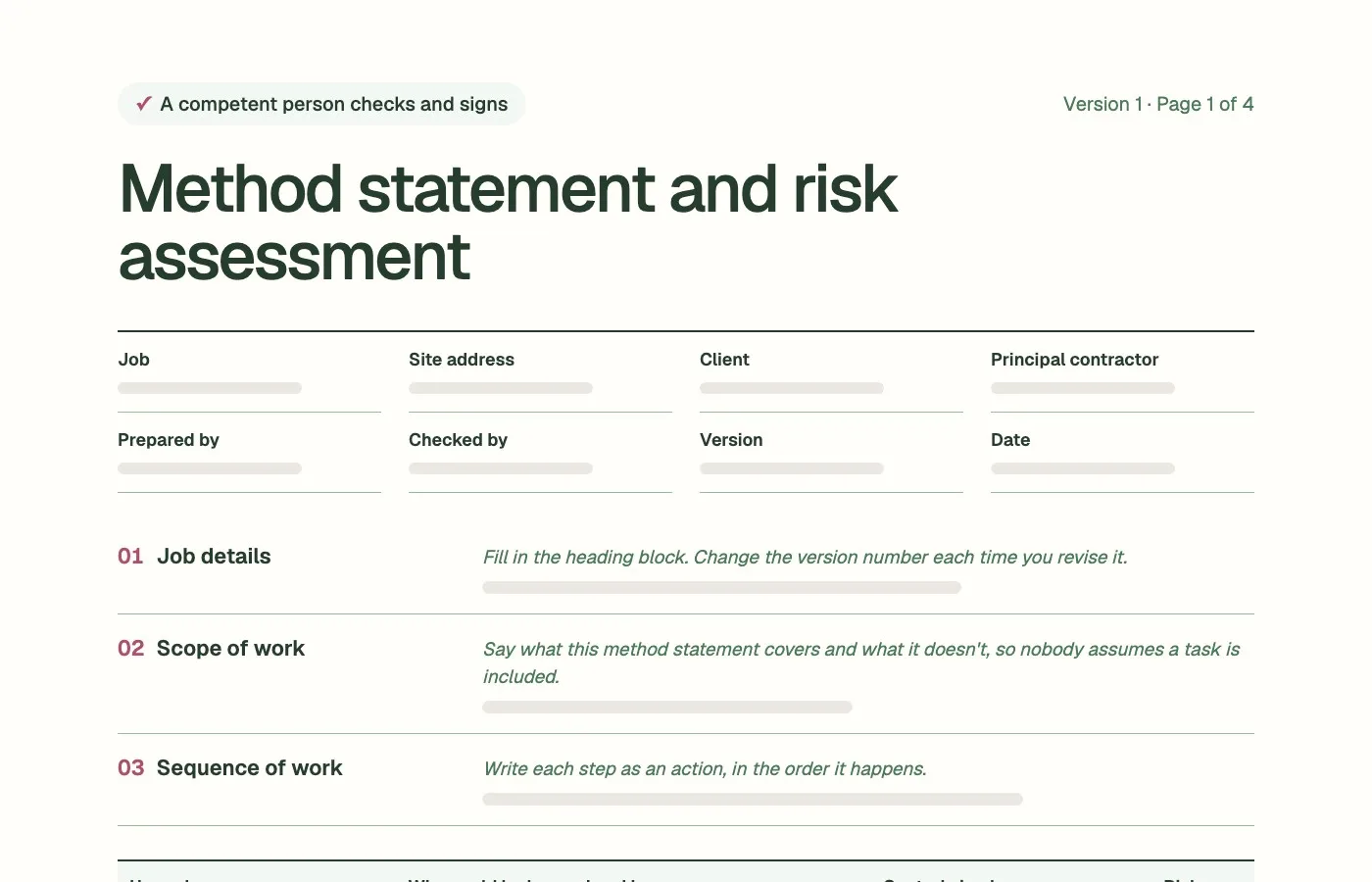
This is the same template as the Word and PDF files, with a line of guidance under each section. Fill it in for the job, then have a competent person check it against the site.
Method statement and risk assessment
A competent person checks this against the site and signs it before work starts.
01Job details
Fill in the heading block. Change the version number each time you revise it.
02Scope of work
Say what this method statement covers and what it doesn't, so nobody assumes a task is included.
03Sequence of work
Write each step as an action, in the order it happens.
04Hazards and controls
For each step, name the hazards and how each one is controlled. Use the risk assessment table at the end.
05People and responsibilities
Name the supervisor and say who does each task.
06Competence and permits
List the training and cards each task needs, and any permits to work.
07Plant, equipment and materials
List what you'll use, and any hazardous substances with their safety data sheets.
08PPE
Say which PPE each task needs, rather than one list for the whole job.
09Emergency arrangements and first aid
Name the first aider and say how to raise the alarm, where the assembly point is and where the nearest A&E is.
10Environmental controls
Say how dust, noise and waste will be controlled, and any limits on working hours.
11Briefing record
Brief the team before work starts and have everyone sign the briefing record at the end.
12Review and sign-off
Review it when the job, the team or the site changes. A competent person checks it against the site and signs it.
Risk assessment
One row per hazard. Rate the risk after the controls are in place.
| Hazard | Who could be harmed and how | Controls in place | Risk (low, medium or high) | Further action | By whom | By when |
|---|---|---|---|---|---|---|
Briefing record
Everyone who does the work signs to show they've been briefed on this method statement.
| Name | Company | Signature | Date |
|---|---|---|---|
Sign-off
A competent person checks this against the site and signs it before work starts.
| Name | Position | Signature | Date | |
|---|---|---|---|---|
| Prepared by | ||||
| Checked by (competent person) | ||||
| Accepted by principal contractor (if required) |
Free to use and change. Check it against your own site before use.
Start from the risk assessment, then walk through the job in the order it happens. Write each step as an action, say who does it and how its risks are controlled, and brief the team before work starts.
Do the risk assessment first. HSE sets out the steps as:
List the work in the order it will happen.
For each step, note the hazards and the controls.
Add the people, equipment, permits and PPE.
Add the emergency arrangements for that site.
Have a competent person check it against the site.
Brief the team and record who attended.
Review it when the job, the team or the site changes.
Here is a short example for a task fit-out firms do often: installing a suspended ceiling in an occupied office. It shows the level of detail to aim for. It isn't a ready-made method statement, so adapt every line to your own site and have a competent person check it.
Installing a suspended ceiling in an occupied office
Example only. Check against your site.
Sequence of work
Hazards and controls
AI can produce a useful first draft of a method statement from the job details and your past RAMS. That cuts the time spent retyping the parts that repeat. It can't see your site, so a competent person must check every step against the work and sign it. HSE hasn't published guidance on AI-written risk assessments.
Give it
Always check
HSE's statement on AI, published on 12 June 2026, says new guidance is planned for 2026/27. Until then, the employer stays responsible for a suitable and sufficient risk assessment, and must appoint competent people to help (Management Regulations 1999, regulations 3 and 7). Have a competent person check any AI draft against the site.
The person responsible for the work signs it once a competent person has checked it, and the team signs the briefing record to show they've been told. Many principal contractors also review and accept RAMS before the work starts.
One page with a record of who attended, plus five starter talks
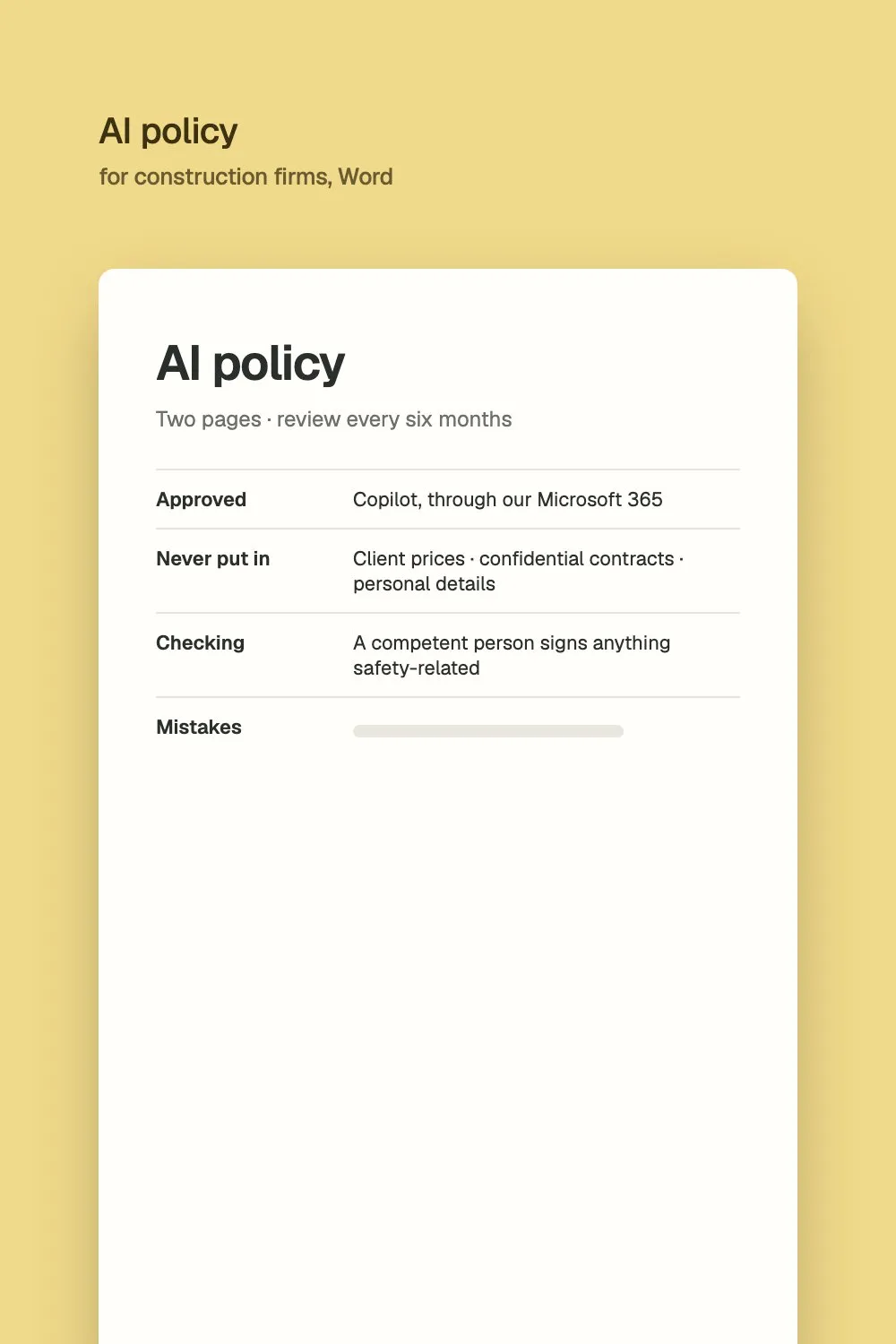
Two pages your team can follow from Monday
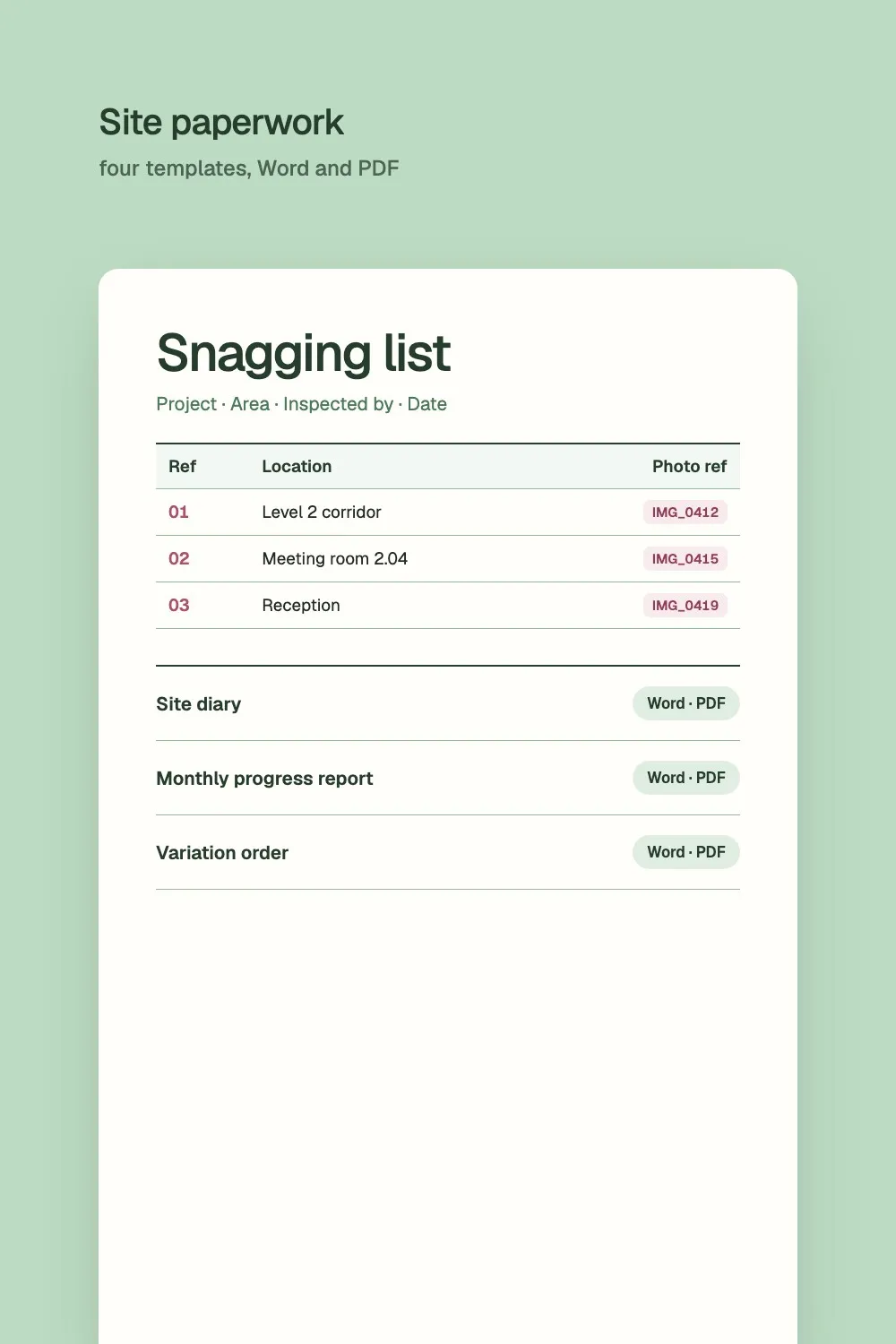
Four Word templates in one download: snagging list, site diary, monthly progress report and variation order
Put it in the check with two other jobs and see which one AI should take on first. Free. Any work after it is agreed separately.