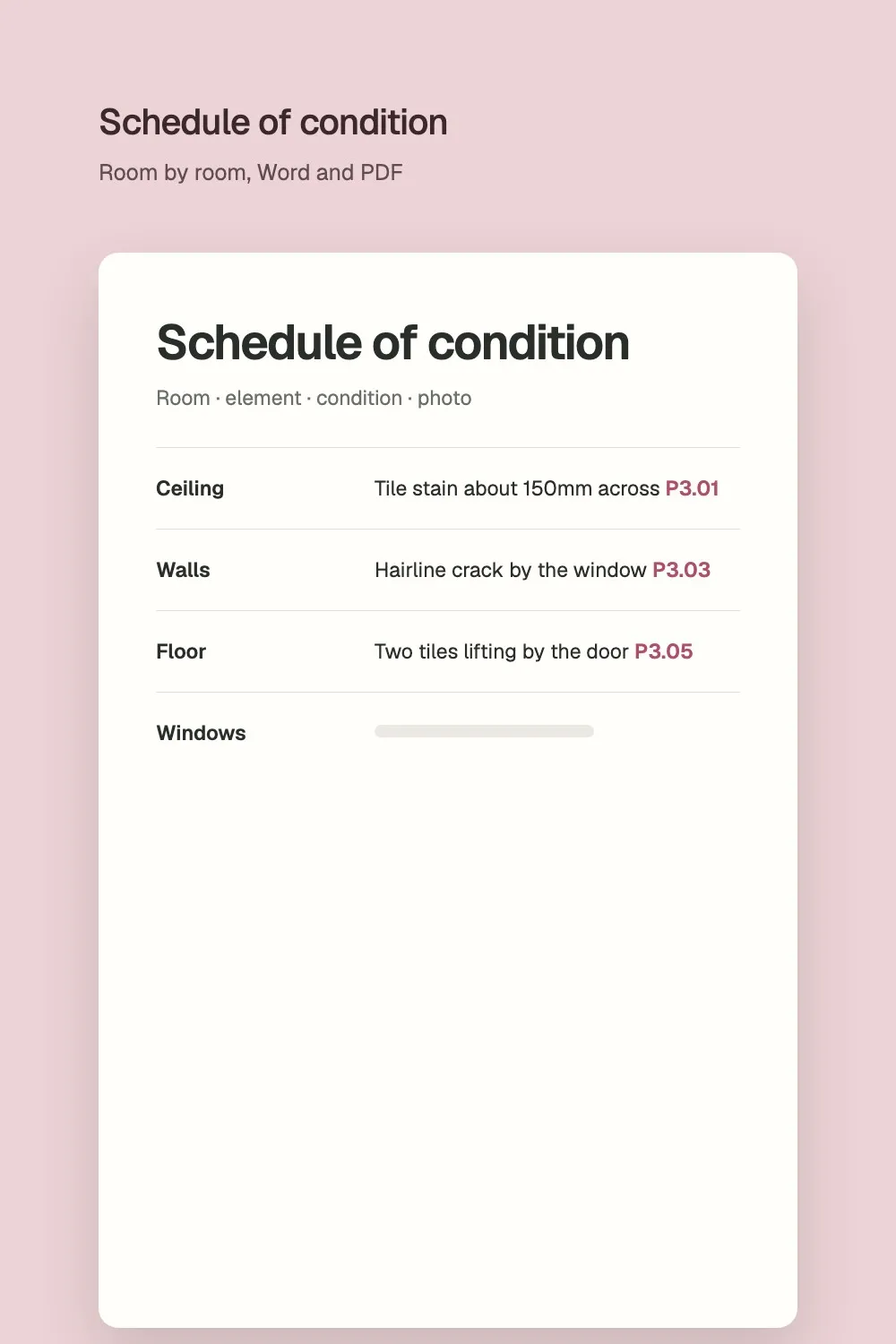
Schedule of condition
Room by room in Word and PDF, with a photo reference for every entry
Last checked 4 October 2026
A free bill of quantities template in Excel, with the sums already set up, and a PDF to print. No email needed. Below it: what a BoQ is, who prepares it, how NRM 2 lays it out, a worked example, and where AI can give your QS hours back.
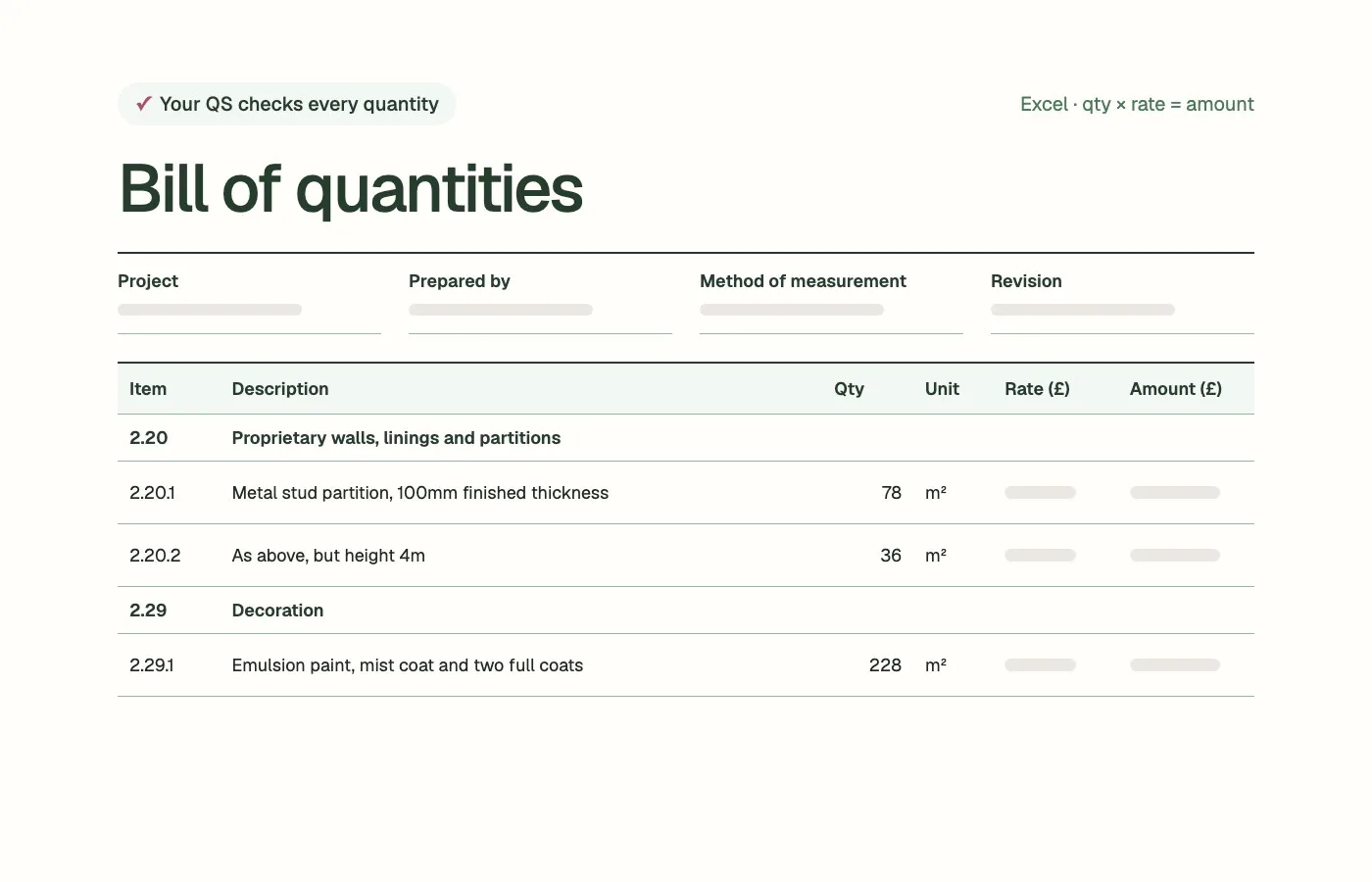
A bill of quantities (BoQ) is a list of the items of work in a building project, each with a description and a quantity. Contractors price it to tender. Once the contract is signed it becomes a contract document, used to value interim payments and varied work. RICS sets out how to measure and describe the items in NRM 2.
A bill saves every tendering contractor from measuring the same design, gives you a consistent basis for comparing bids, and sets out clearly what work is included. After the contract is signed, it's the basis for valuing variations and interim payments. Priced bills also become cost data for estimating your next project.
Every tendering contractor prices the same measure, so nobody has to measure the design themselves.
Bids are like for like, which makes them easier to compare.
The work is set out clearly, item by item, before anyone prices it.
It runs the job after signing: valuing variations and interim payments, and forecasting cash flow.
Priced bills become cost data for estimating your next project.
On a traditional lump-sum contract, the client's quantity surveyor or cost manager normally prepares the bill. Under design and build, the client's team writes the employer's requirements, and the main contractor or package contractors produce the bill or quantified schedules. NRM 2 says who measures depends only on the client's choice of contract strategy.
| Contract strategy | What goes out to tender | Who measures |
|---|---|---|
| Traditional lump sum | A firm or approximate bill | The client's quantity surveyor or cost manager |
| Design and build | The employer's requirements | The main contractor or package contractors, from those requirements |
| Management or construction management | A firm or approximate bill | The client's quantity surveyor or cost manager, or the main contractor, depending on the tender documents |
NRM 2 lists the usual sections: form of tender, summary, preliminaries, measured works, non-measurable works, provisional sums, contractor-designed works, risks, credits, dayworks and annexes. The measured works are the main part, ordered by element, work section or works package. Each bill's total carries to the summary, then to the form of tender.
Form of tender: the contractor's price. It can be a separate document.
Summary: every bill's total, carried to one tender figure.
Preliminaries: site set-up, management and the client's requirements, priced by the contractor.
Measured works: the main part, with every item described and measured.
Provisional sums: work that's expected but not yet designed.
Contractor-designed works: parts the contractor will design, with the performance they must meet.
Risks: risks passed to the contractor for a fixed price.
Credits: materials from the works that the contractor can keep.
Dayworks: rates for work that may be valued on time and materials.
Annexes: anything the bill refers to that isn't issued separately.
Each item needs a reference, a description, a quantity and a unit, with columns for the contractor's rate and the amount. NRM 2 says descriptions should give the type and quality of material, its critical dimensions, the fixing method where it isn't left to the contractor, and the background it's fixed to.
NRM 2's measurement rules come down to a few habits worth keeping on every bill:
Measure work net, as fixed in position, unless the rules say otherwise.
Give quantities to the nearest whole number, except tonnes, which go to two decimal places.
Measure dimensions to the nearest 10mm.
Put the unit against every item, even when it's the same as the line above.
Say in the bill that it's prepared to NRM 2.
A firm bill measures a fully designed project so you get a lump-sum price. An approximate bill is for when the design isn't detailed enough, or a firm bill isn't worth the time, and the work is remeasured on completion. NRM 2 says to use approximate bills only when time is short or parts of the work are very uncertain.
Smaller jobs often go without a bill. JCT's guidance for its Minor Works contract says that contract expects a lump-sum price from drawings, a specification or work schedules, without the employer providing bills of quantities.
This is the same layout as the Excel and PDF files. The Excel version multiplies each quantity by its rate, adds up each section and carries every bill to the summary, so the tender total updates as the contractor prices it.
Bill of quantities
Your quantity surveyor checks every quantity and description before the bill goes out to tender.
The bills
01Preliminaries
Set out the project particulars, the drawings, the contract and the client's requirements. The contractor prices each heading as time-related and fixed charges.
02Measured works
One block for each element, work section or works package. Describe and measure every item to NRM 2, with its unit. The contractor fills in the rates.
03Provisional sums
Work you expect but can't yet design or measure, including work by statutory undertakers. Say whether each sum is for defined or undefined work.
04Risks
Risks you want the contractor to take on, each described fully. The contractor prices a lump sum for each one.
05Dayworks (provisional)
Estimated hours for each kind of labour, and lump sums for materials and plant, for the contractor to add rates and percentages to.
06Credits
Materials from stripping out or demolition that the client is happy for the contractor to keep, with the credit offered for each.
Bill 2: Measured works
Item, description, quantity and unit from you. The contractor adds the rate, and the Excel file works out each amount and total.
| Item | Description | Qty | Unit | Rate (£) | Amount (£) |
|---|---|---|---|---|---|
| {Work section or element} | |||||
| Total carried to collection | |||||
Summary
| Bill | Amount (£) |
|---|---|
| 1. Preliminaries | |
| 2. Measured works | |
| 3. Provisional sums | |
| 4. Risks | |
| Overheads and profit, {%} | |
| 5. Dayworks, if in the contract sum | |
| 6. Less credits | |
| Total carried to form of tender |
Measure every item to NRM 2 and give its unit: m, m², m³, nr, kg, t. Quantities go to the nearest whole number, except tonnes, which go to two decimal places.
Free to use and change. Your QS checks every quantity before the bill goes out.
Here's how three work sections of a small office fit-out look in a bill, with the quantities in and the rate and amount columns left for the contractor. It shows the layout and the level of description to aim for. The quantities are made up, so measure your own from the drawings.
Office fit-out, second floor: measured works
Illustrative layout. No rates or prices.
2.20Proprietary walls, linings and partitions
2.29Decoration
2.30Suspended ceilings
Yes, with the parts that take hours but follow a pattern. AI can draft item descriptions in your house style from the specification and the take-off, and check the bill against the drawings for items missed or counted twice. The measurement stays with your QS, who checks every quantity and description and signs off the bill.
Give it
Always check
If you're an RICS member or your firm is regulated by RICS, its standard on responsible use of AI has applied since 9 March 2026. Where an AI output has a material impact on your service, you need a written decision on whether it's reliable. The RICS AI standard guide sets out what your firm needs in place.
Room by room in Word and PDF, with a photo reference for every entry
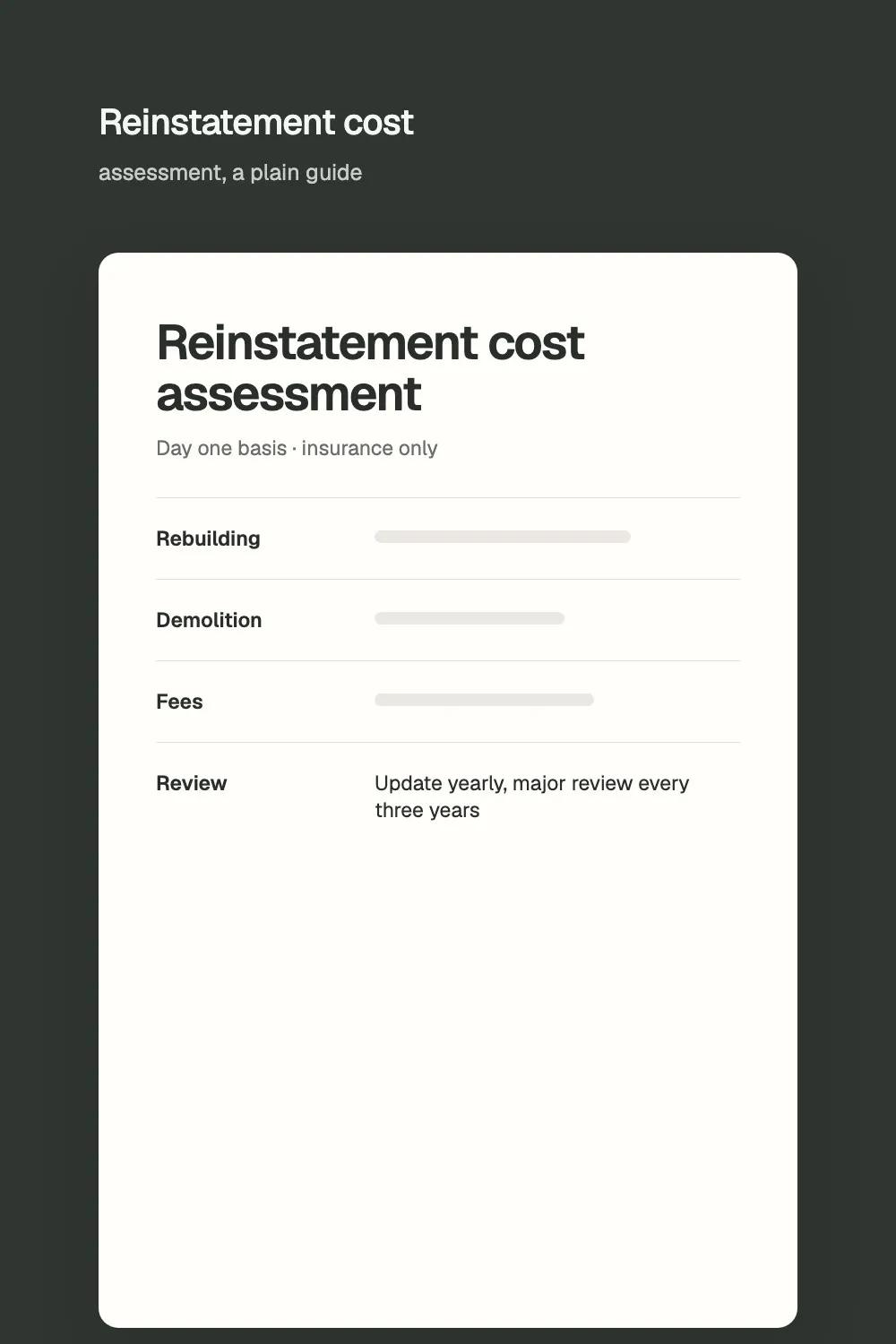
What it covers, how it differs from market value and how often to review it
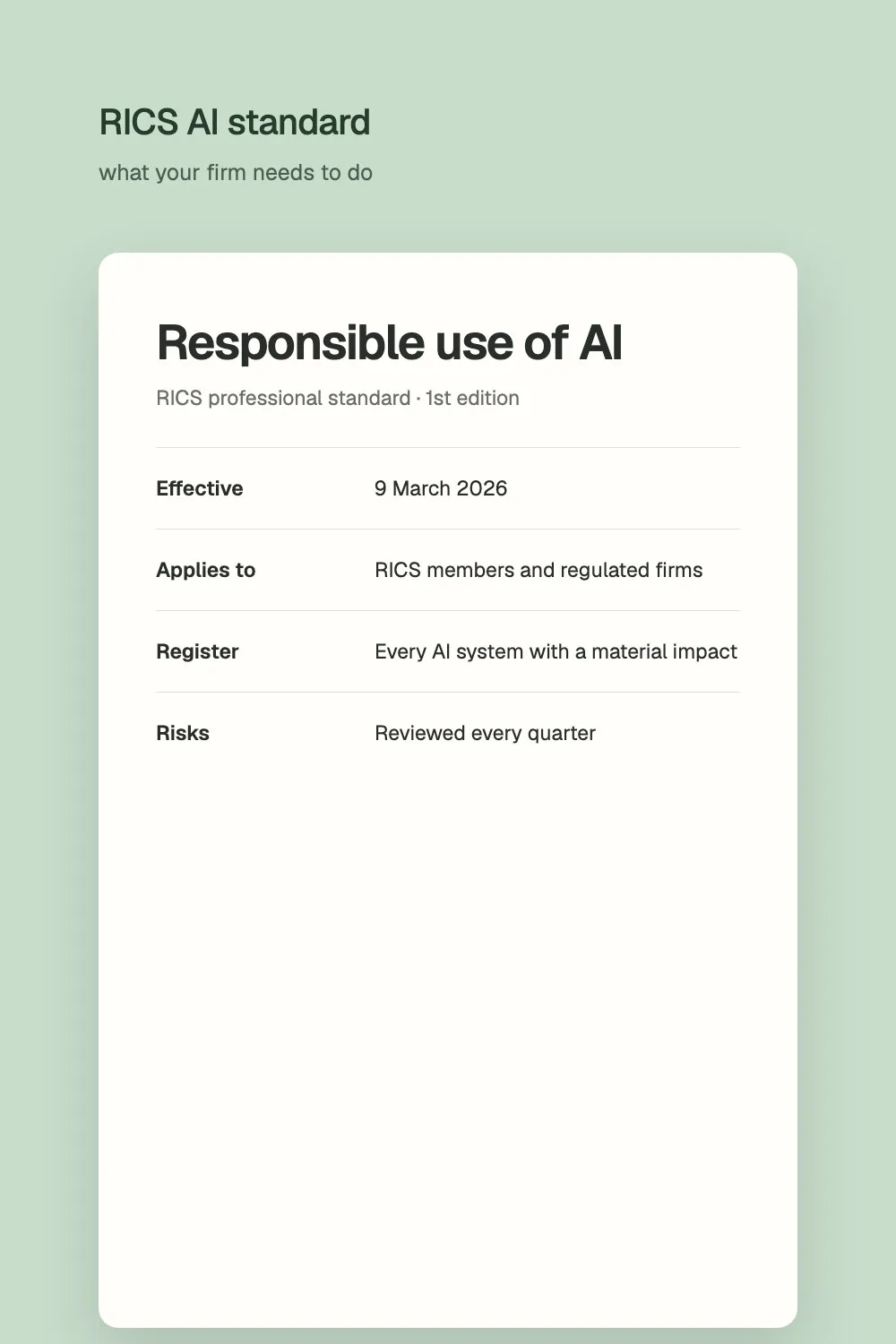
What your firm needs in place, with a free AI register and risk register
The role under JCT and NEC4, the paperwork, and where AI helps
The check puts bills of quantities next to the rest of your office work, such as valuations, payment runs and monthly reports, and shows which job AI should take on first. Free. Any work after it is agreed separately.